Restoration
Fire and smoke damage restoration
Emergency board-up and tarps go on the same night, before anything else. From there it is documentation, smoke and water removal, and a rebuild back to what it was before.
Chapter 01
Board-up and tarps, before anything else
Emergency board-up and tarps are the first thing that happens, often the same night as the fire. An open roof or a blown-out window is not a restoration problem yet, it is a weather and security problem, and it has to be closed off before anything inside can safely be assessed.
Everything else in the process depends on the structure being secured first. Assessment on an open building is unreliable, and so is any work started before the space is protected from rain, wind and anyone who might wander in.
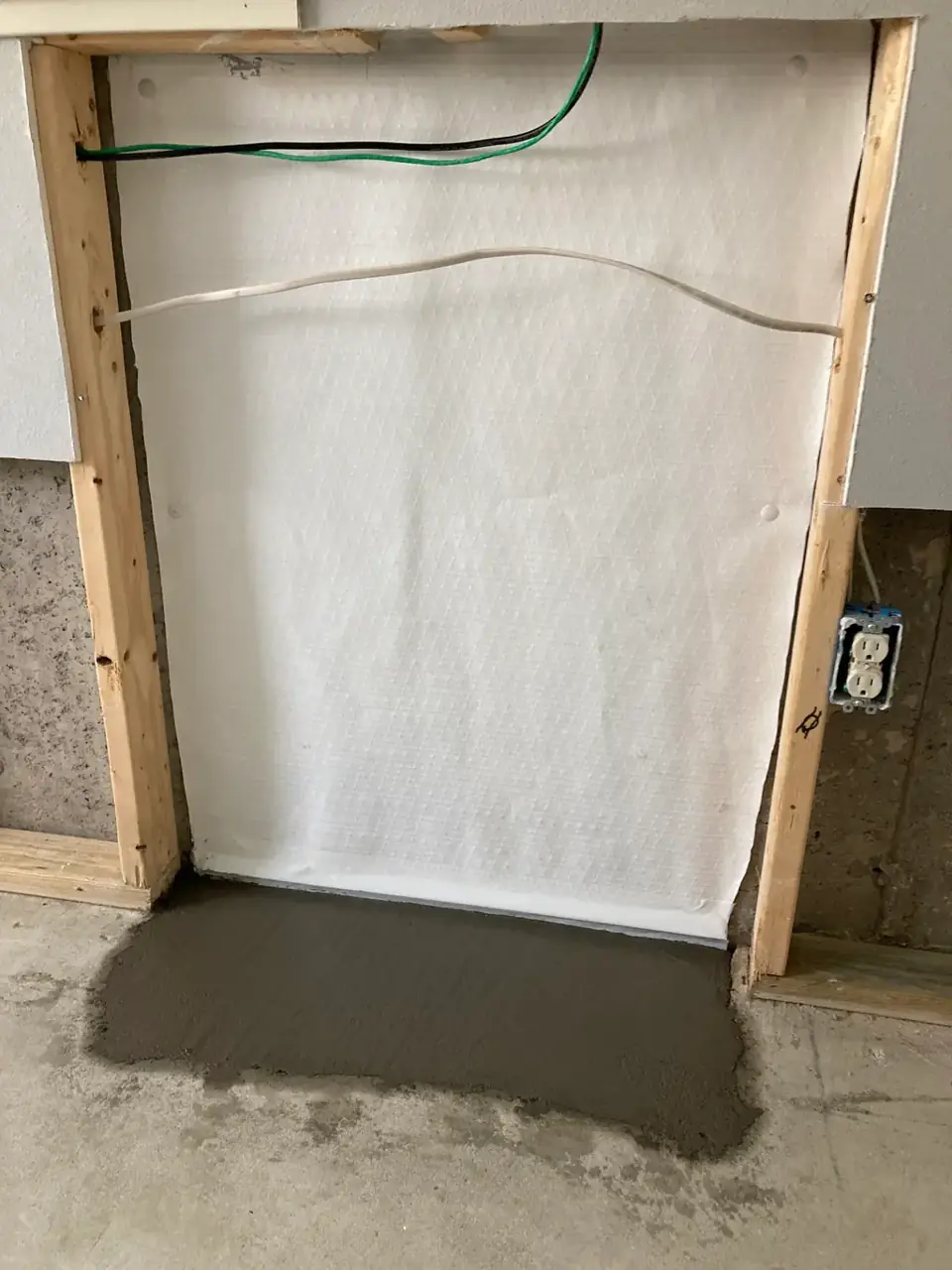
Exposed wall framing, insulation board and a fresh concrete patch mid-restoration after fire damage
Damage assessment and documentation, before the real work starts
Once the structure is secured, the loss gets documented: what burned, what is smoke-damaged but structurally sound, and what water reached during the fire response. That documentation is what the rest of the job gets planned against, and it is also what an insurance adjuster needs to see.
Insurance claim assistance runs through this from the start, with detailed estimates and direct coordination with the adjuster, not a summary written up after the work is already done.
Chapter 03
Smoke and soot are chemistry, not a smell to cover up
Smoke and soot removal is not a deodorizing job. Soot is a chemical residue that etches into surfaces and smoke odor is carried by particles small enough to work into porous materials, walls, ceilings, HVAC components. Covering that with a scent does nothing to the source.
Thermal fogging and hydroxyl generators are what actually break the odor down at the particle level, on surfaces and in the air, rather than masking it. That is the difference between a house that smells fine for a week and one that is actually clean.
The fire is put out with water, so this is a water job too
A structure fire is extinguished with water, which means every fire loss is also a water loss. Water extraction and drying happen once the fire service has cleared the scene, following the same standard as any other water damage: pulling water out first, then drying the assembly, not just the surface.
Skipping that step because the damage looks like a fire problem is how a fire loss turns into a mold problem on top of everything else it already is.
Content cleaning and pack-out
Belongings that can be saved get packed out and cleaned off site, away from the smoke and soot still settling in the structure while repair work is underway. Cleaning contents in place, inside a house still being worked on, just re-exposes them to the same residue.
What comes back afterward has actually been cleaned, not wiped down once and returned to a room that still needs work.
Reconstruction back to pre-loss
Repair and reconstruction is the last phase: rebuilding what was removed or opened up during board-up, assessment and drying, framing, insulation, drywall, concrete patching, back to what the space was before the loss.
The same crew that boarded up the windows the first night is the one that hands the space back finished, which is the point of running fire restoration as one job instead of handing it off between separate contractors at every stage.
Pet-safe, eco-friendly products and a family crew that has answered fire and water losses out of Rochester and La Crosse since 1987.
What this covers
One crew, board-up through reconstruction
- Emergency board-up and tarps, 24/7/365.
- Damage assessment and documentation for your insurance claim.
- Smoke and soot removal by thermal fogging and hydroxyl generators.
- Water extraction and structural drying after the fire service has cleared.
- Content cleaning and pack-out.
- Repair and reconstruction back to pre-loss.
Current offer
Running now on remediation work
- 10% off: Remediation services. Water, mold, fire and smoke cleanup. Up to $250 off.